Free PDF · ages 8–14
Free speed training plan for kids (PDF)
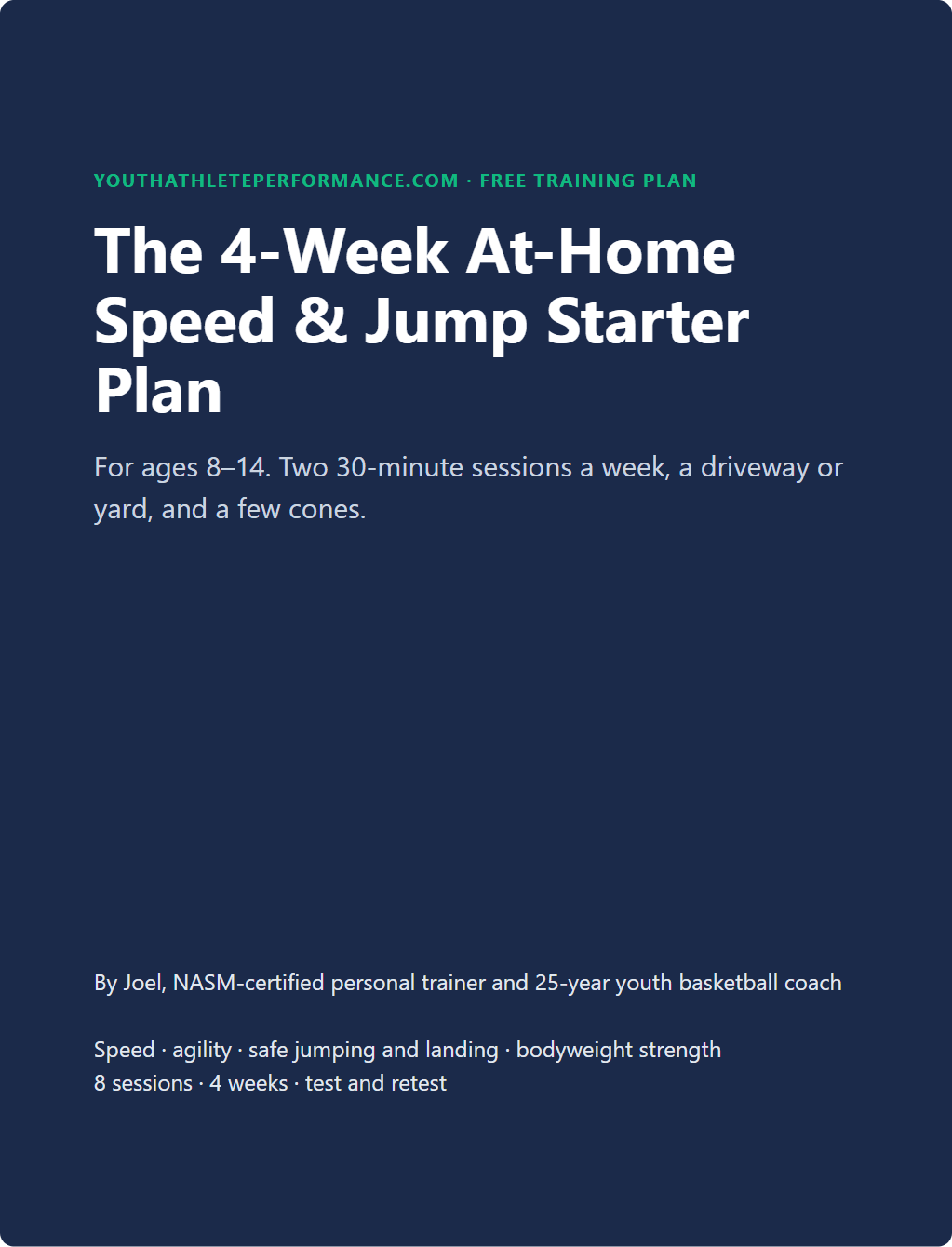
The 4-Week At-Home Speed & Jump Starter Plan: two 30-minute sessions a week at home, a driveway or yard, and a few cones. 20 pages, with a printable card for every session.
What's in the PDF
- ✓Eight sessions over four weeks: two a week, about 30 minutes each, in a driveway, yard or park.
- ✓Sprint starts, max-speed runs and change of direction first, then safe jumping and landing, then bodyweight strength.
- ✓Separate doses for ages 8–10 and 11–14, with a coaching cue for every exercise.
- ✓Three simple tests in week 1 and the same tests in week 4, with a score sheet, so your athlete sees the progress.
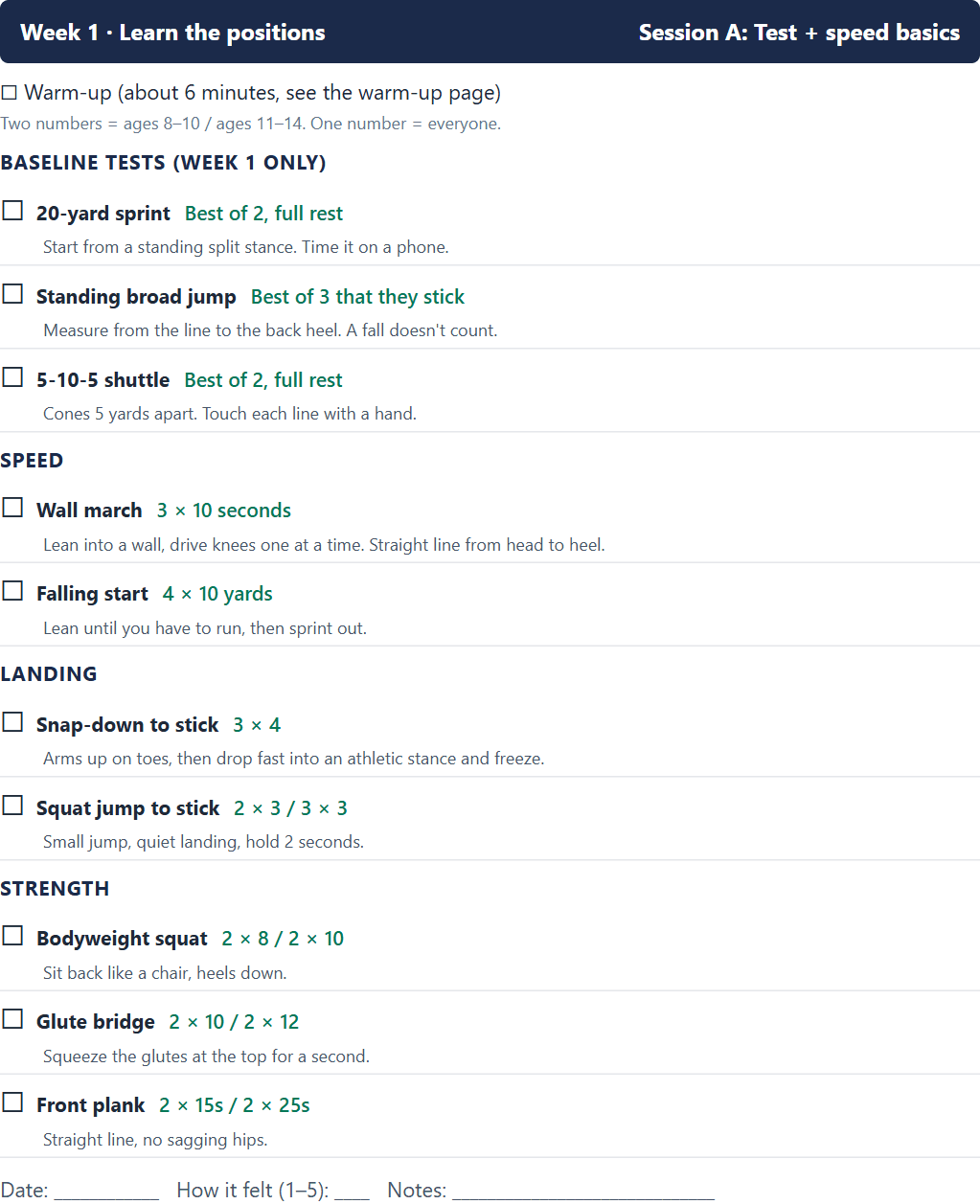
- ✓A printable card for every session: tape it to the garage wall and check off each set.
Built by Joel, a NASM-certified personal trainer and 25-year youth basketball coach, following the American Academy of Pediatrics' guidance on youth strength training: supervised, technique first, progress slowly. Enter your email and confirm it. Your personal link opens the plan with the PDF download right away.
A look inside
The rules we follow
- Two sessions a week, never on back-to-back days, and not the day after a hard game or tournament. On weeks with lots of games, do one session or none.
- An adult watches. The AAP is clear that youth strength and power training should be supervised, with technique coming first.
- Quality beats quantity. Rest a full 60–90 seconds between sprints, and stop a set the moment form gets sloppy.
- Landing first: every jump ends in a quiet, two-second "stick" with knees over toes and hips back. If they can't stick it, the jump is too big.
- Ages 8–10 use the lower number and treat everything like a game. Ages 11–14 use the higher number once the lower one looks easy.
- Pain is a stop sign. Sharp pain, pain that changes how they move, or knee or heel pain during a growth spurt (Osgood-Schlatter, Sever's disease) means stop jumping and check with a pediatrician or athletic trainer.
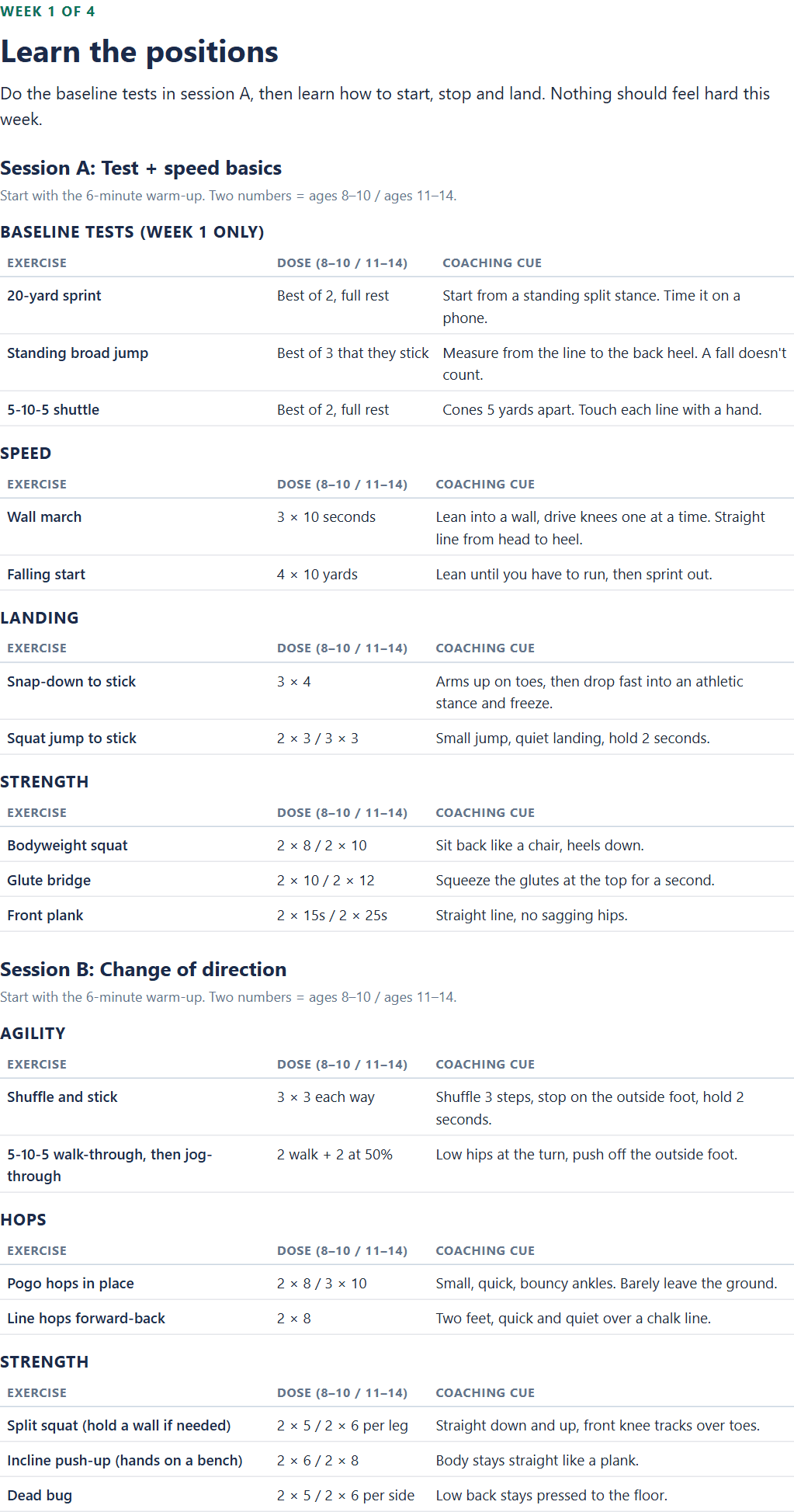
Preview: week 1
Weeks 2–4 add distance and speed step by step, then retest.
Week 1
Learn the positions
Do the baseline tests in session A, then learn how to start, stop and land. Nothing should feel hard this week.
Session A: Test + speed basics
Start with the 6-minute warm-up.
Baseline tests (week 1 only)
| Exercise | Dose (8–10 / 11–14) | Coaching cue |
|---|---|---|
| 20-yard sprint | Best of 2, full rest | Start from a standing split stance. Time it on a phone. |
| Standing broad jump | Best of 3 that they stick | Measure from the line to the back heel. A fall doesn't count. |
| 5-10-5 shuttle | Best of 2, full rest | Cones 5 yards apart. Touch each line with a hand. |
Speed
| Exercise | Dose (8–10 / 11–14) | Coaching cue |
|---|---|---|
| Wall march | 3 × 10 seconds | Lean into a wall, drive knees one at a time. Straight line from head to heel. |
| Falling start | 4 × 10 yards | Lean until you have to run, then sprint out. |
Landing
| Exercise | Dose (8–10 / 11–14) | Coaching cue |
|---|---|---|
| Snap-down to stick | 3 × 4 | Arms up on toes, then drop fast into an athletic stance and freeze. |
| Squat jump to stick | 2 × 3 / 3 × 3 | Small jump, quiet landing, hold 2 seconds. |
Strength
| Exercise | Dose (8–10 / 11–14) | Coaching cue |
|---|---|---|
| Bodyweight squat | 2 × 8 / 2 × 10 | Sit back like a chair, heels down. |
| Glute bridge | 2 × 10 / 2 × 12 | Squeeze the glutes at the top for a second. |
| Front plank | 2 × 15s / 2 × 25s | Straight line, no sagging hips. |
Session B: Change of direction
Start with the 6-minute warm-up.
Agility
| Exercise | Dose (8–10 / 11–14) | Coaching cue |
|---|---|---|
| Shuffle and stick | 3 × 3 each way | Shuffle 3 steps, stop on the outside foot, hold 2 seconds. |
| 5-10-5 walk-through, then jog-through | 2 walk + 2 at 50% | Low hips at the turn, push off the outside foot. |
Hops
| Exercise | Dose (8–10 / 11–14) | Coaching cue |
|---|---|---|
| Pogo hops in place | 2 × 8 / 3 × 10 | Small, quick, bouncy ankles. Barely leave the ground. |
| Line hops forward-back | 2 × 8 | Two feet, quick and quiet over a chalk line. |
Strength
| Exercise | Dose (8–10 / 11–14) | Coaching cue |
|---|---|---|
| Split squat (hold a wall if needed) | 2 × 5 / 2 × 6 per leg | Straight down and up, front knee tracks over toes. |
| Incline push-up (hands on a bench) | 2 × 6 / 2 × 8 | Body stays straight like a plank. |
| Dead bug | 2 × 5 / 2 × 6 per side | Low back stays pressed to the floor. |
Common questions
Is there a free speed training PDF for kids?
Yes. This 4-week plan is a free 20-page PDF for ages 8–14. Enter your email and confirm it, and your personal link opens the plan with a Download the PDF button. You can also print it straight from the page.
What ages is this speed training plan for?
Ages 8–14. Every exercise has one dose for ages 8–10 and a slightly higher one for ages 11–14. Under 8, kids get faster mostly through play: tag, races and chase games. Teens 15 and up can use it as a starting block, but most will be ready for more.
What equipment do we need?
A few cones (shoes or water bottles work), a phone stopwatch, a tape measure, and about 30 yards of flat space like a driveway, yard or park. No weights.
Is speed training safe for kids?
Yes, when it is supervised, technique comes first and the volume is low. The plan follows the American Academy of Pediatrics guidance on youth strength and power training: two non-consecutive days a week, full rest between sprints, and every jump ends in a controlled landing.
Can my child do it during the season?
Yes. On weeks with a lot of games, do one session or skip a week. Never do a session the day after a hard game or tournament.
Want the reasoning behind the plan? Read speed training for kids by age, speed and agility drills for kids at home, and plyometrics for kids.